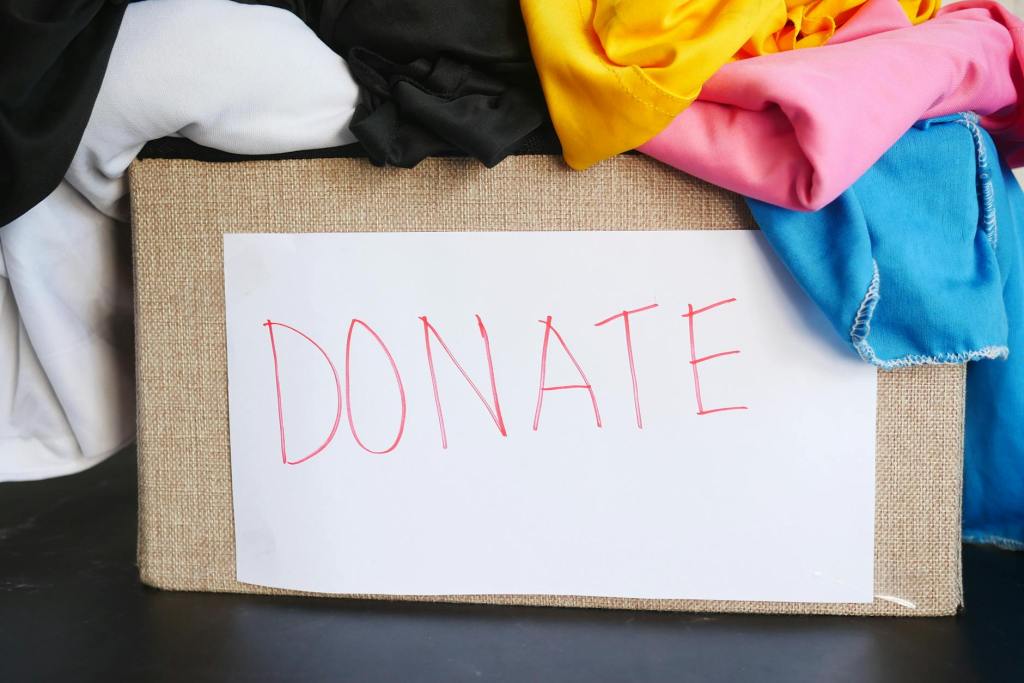
I was on the hunt for Breit Lights’ next fundraising mission. I wasn’t quite sure what it was going to be. I had been focused on education. Getting knowledge to the future generation to help them implement sustainable everyday actions. I had also created a sustainability policy for our school district and worked with the local businesses to assess and implement sustainable measures. So, what else could I do? That was the problem sometimes. I never could rest. I always feel like more can be done. I began looking into local organizations. Most organization’s fundraising activities are focused around raising money to support their environmental efforts. I have done that in the past. Not that there is anything wrong with that, but I felt like I wanted to do something a little more hands on. Then I stumbled across all of these organizations that collected clothing with the goal of helping the environment. So, I collected a bunch of clothing and had my mom bring me to one of these organizations’ headquarters. Unfortunately, when I arrived, I was told that the clothes were sold for a small fee to individuals and then a portion of the proceeds were given to the environmental organization. This was not exactly what I was looking to do, so I packed up our car and started again. Back to the internet.
I started reading all about clothing and the environment. Let me tell you there was a lot to read. Approximately 100 billion clothing garments are produced each year. Approximately 90% of it lands up in landfills and only about 1% is recycled. Well, that was certainly eye opening. That definitely puts things into perspective. Through my research I also learned that the average person buys about 60% more items of clothing than they did 15 years ago. I can’t help but think about this in terms of my own life. I start to think about all of the trendy, inexpensive clothing that my friends and I have been buying and the guilt starts to set in. But who knew. Of course, now I do and now I will be more diligent.
However, to fully understand the impact of clothing on the environment we need to start from the beginning. The making of the clothing items. The production of clothing uses massive amounts of water. For example, it takes about 2,700 liters of water to produce one cotton t shirt. That’s enough water for a person to drink for 2 entire years!!! Additionally, synthetic textiles such as polyester, nylon, spandex and acrylic take hundreds of years to biodegrade. When these materials are washed, microplastics (tiny pieces of non-biodegradable plastic) are shed and end up in our water system and eventually our oceans. The dyeing of the fabrics leads to carbon dioxide emissions and water pollution. Also, did you know that materials such as rayon and viscose are made from wood pulp causing millions of tons of trees to be cut each year leading to the deforestation of our planet? And that polyester is made from fossil fuels and uses millions of barrels of oil each year. Synthetic fabrics can take up to 2 years to break down and as they do, they produce methane, a powerful global warming greenhouse gas.
After all this reading I know what I have to do. I have to prevent clothing from ending up in landfills. I need to work to help it get recycled and reused. Not just my household’s items but items from my entire community. In my looking for organizations that do this I find Wearable Collections. It piques my interest. According to their website, the items collected by Wearable are handled accordingly: 50% of the items collected are reused. All reusable items are distributed to secondhand markets overseas where they provide job opportunities and high-quality clothing to low-income communities. 26% of the items are shredded. The low-grade fiber material is then used in carpet padding, insulation, acoustic dampening materials and furniture stuffing along with other end uses. 20% of the items are repurposed into rags. I also learn that Wearable partners with organizations to host clothing fundraising drives. So, I reach out to them so that Breit Lights can partner with them. It takes some time and numerous follow-ups, but finally I am in touch with someone who helps me finalize the partnership and a large BLUE donation bin is delivered to my driveway. As it is for an environmental purpose, I would have thought that it would have been green but that’s okay the letters are in green. I quickly put together a flyer and send it to friends and family. I also put a copy of it on my website and bring it to local shops for display. To date, Breit Lights has collected over 900 gallons of clothing. In all honesty, I did not weigh the clothing. I am using the guidance provided by Wearable. To give some clarification, one large black garbage bag holds about 30 plus gallons, one average kitchen bag holds about 13 gallons, and an average grocery bag holds about 5 gallons of clothing. My clothing fundraiser is continuous and as the months go on, I collect more and more clothes. I could not be happier. And even though at times saving the planet feels overwhelming, every once in a BLUE moon you feel like you are really making a difference.
 BreitLights
Leave a comment